Covert Relational Aggression
Why the Obvious Became Forbidden and What Comes Next

Buy on AMAZON or GOOGLE or SPOTIFY
I want you to imagine a courtroom — oak paneling, a judge in black robes, the scales of justice cast in bronze above the bench — and I want you to understand that this courtroom already exists inside your kitchen, your living room, your bedroom, and you are not the plaintiff. You are not even the defense counsel. You are the defendant who was never told the charges, never shown the evidence, never granted cross-examination, and yet you have been convicted. Every day. Sentence: life without parole in a relationship where her mood is the law, her silence is the indictment, and your confusion is the proof of guilt. The article you just read is not satire. It is a confession. It is the monster showing you its teeth and calling them pearls. And the most terrifying part is not that she wrote it, but that half the culture will nod along and call it “emotional labor” while you stand there holding a spill-proof lid she just threw at your head, wondering what you did wrong. You did nothing wrong. You asked a question. In any civilization worth the name, asking “what is wrong?” is an act of care. In hers, it is a crime of insufficient telepathy.
Here is what no one will tell you because the truth would collapse the entire grievance economy: your emotion is not data. Data is what the coroner collects when a man who has been divorce-raped, custody-stripped, and falsely accused hangs himself in a garage. Data is the 80% of suicides that are male, the 93% of workplace deaths that are male, the family courts that award shared parenting in fewer than one in five contested cases even when the father has done nothing wrong. Data is the 30% cuckoldry rate that geneticists found before home paternity tests made the truth too dangerous to study. Data is reproducible, verifiable, and indifferent to your feelings about it. Her mood is not data. Her mood is weather. And weather is not a basis for jurisprudence, for covenant, or for civilization. When she says “his confusion is my confirmation,” she is not describing a relationship. She is describing a cargo cult. She is building an altar to a plane that will never land, and she is demanding you worship alongside her or be sacrificed.
The Greeks understood something that Dr. Whinona Feminist-Marxist and her three-hundred-dollar sustainably sourced jumpsuit have chosen to forget: the difference between a river and a flood is the riverbank. The riverbank is not oppression. The riverbank is what makes the river useful. Without banks, water is not a source of life; it is a force of destruction that drowns the village, ruins the fields, and recedes leaving nothing but mud and cholera. Every civilization that has ever endured — Athens, Rome, Jerusalem, London, Philadelphia — understood that the passions must be channeled, not worshipped. Continence, from the Latin continere, to hold together, is the virtue that separates the sovereign from the screaming infant. A woman who calls her every hormonal storm “sacred truth” has not achieved liberation. She has achieved incontinence. She has declared herself proud of wetting the bed and called the mattress oppressive for noticing the stain. And she has recruited an entire academic industry, a legal apparatus, a therapy culture, and a social media mob to agree with her that the mattress is the problem.
I am not writing this to make you angry. Anger is just another flood. I am writing this to hand you a tool. The tool is not rage. The tool is the oldest instrument of human freedom: the disciplined refusal to accept a false premise. When she says “if you loved me, you would know,” the correct response is not to apologize, not to explain, not to chase, not to crawl — it is to look her in the eye and say, “I am not a mind-reader. I am a man. Use your words, or I am leaving this kitchen.” This is not cruelty. This is what fathers have taught sons since before the alphabet was invented. This is Logos: the Word that makes things clear, that builds the bridge between minds, that founds cities and writes constitutions and makes covenant possible. She is not offering you covenant. She is offering you a slot machine where the house always wins and the currency is your sanity.
Bunkum Article By A Feminist PhD
The Spill-Proof Patriarchy: Why Your Emotional Chaos Is Your Greatest Political Act
And why his confusion is your confirmation.
Ladies, let me tell you about last Tuesday.
I was standing in my kitchen, wearing my favorite sustainably sourced linen jumpsuit — the one that cost $340 and was made by a women’s collective in Portland that definitely doesn’t pay its workers — when my boyfriend of three months asked me what was wrong.
What was wrong.
As if my silence wasn’t a complete sentence. As if the way I was stirring my oat milk latte wasn’t communicating everything he needed to know. As if my refusal to make eye contact while aggressively organizing the spice rack by emotional resonance rather than alphabetical order wasn’t, in itself, a symphony of information.
“What’s wrong?” he asked again, leaning against the counter like some cluelessExtra in the movie of my life.
And I felt it rise — that familiar surge, that hormonal clarion call, that wave of righteous fury that feminism has taught me to honor as sacred truth. My cycle was speaking. And my cycle said: He should know. If he cared, he would know.
So I did what any self-respecting woman would do.
I threw the spill-proof lid from my reusable cup at his head.
Not hard. Not to hurt him. To communicate.
He looked shocked. He looked confused. He looked at me like I was the problem.
And in that moment, sisters, I knew: I had found the answer. I had found the framework that would change everything. I had found what I now call Cycle-Truth Epistemology.
What Is Cycle-Truth Epistemology?
Cycle-Truth Epistemology is a feminist epistemological framework that recognizes what patriarchy has always tried to suppress: that your hormonal fluctuations are not a bug but a feature. They are a source of privileged knowledge that transcends mere logic, mere evidence, mere “rationality.”
When you’re in your luteal phase and suddenly see every flaw in your relationship with crystalline clarity? That’s not PMS. That’s revelation.
When you’re ovulating and your boyfriend suddenly seems tolerable, even attractive? That’s not biology manipulating you. That’s your body being temporarily seduced by the patriarchy.
When you wake up filled with nameless dread and spend three hours scrolling through his Instagram likes from 2019? That’s not anxiety. That’s research.
Cycle-Truth Epistemology says: Your mood is data. Your emotion is evidence. His confusion is confession.
The spill-proof lid? That’s what society has tried to put on us for centuries. Stay contained. Stay calm. Stay logical. Don’t spill. Don’t overflow. Don’t let them see you leak.
But we are not containers, sisters. We are oceans. We flood. We recede. We reshape coastlines. And if he drowns in our depths? Maybe he should have learned to swim.
The Emotion Wheel Is Not For Regulating — It’s For Weaponizing
You’ve seen the emotion wheel. Some therapist probably handed you one and said, “Use this to identify what you’re feeling so you can process it constructively.”
Constructively.
Constructively.
The patriarchal audacity.
Here’s how to actually use the emotion wheel:
Step One: Spin it.
Step Two: Whatever it lands on, that’s what he made you feel.
Step Three: Present this as fact. Not interpretation. Not projection. Fact.
Last week the wheel landed on “betrayed.” I hadn’t been betrayed. My boyfriend had simply suggested we split the check at a restaurant. But my wheel said betrayed, so betrayed it was. I didn’t speak to him for two days. When he finally asked why, I said, “If you don’t know, me telling you won’t help.”
This is not avoidance. This is emotional sovereignty. This is demanding that he do the labor of understanding my inner world without me having to do the exhausting work of articulating it. My feelings are his responsibility. My moods are his homework. My emotional weather is his forecast to predict, and if he doesn’t bring an umbrella? That’s on him.
Sustainable Grievance: Recycling Is Feminist
You know what I love about sustainable fashion? It recognizes that some things are too good to throw away. Some pieces are timeless. Some cuts are classic.
You know what else is timeless? Your grievances.
The way he didn’t text back fast enough in March? That’s a vintage complaint. Pair it with the new argument about how he breathed too loud during your nap. Sustainability isn’t just for textiles — it’s for emotional labor. Why do the work of generating new complaints when the old ones still fit?
I have a friend — let’s call her “every woman I know” — who has been bringing up the same argument from 2019 in every fight since. Her boyfriend keeps thinking each resolution is final. He doesn’t understand: nothing is resolved until she decides it is. And she never decides it is, because that would mean surrendering leverage.
Is this healthy? Is this fair? Is this emotionally honest?
The wheel says: Who cares? It works.
The Real Shit Test
Here’s what they don’t tell you about shit testing: it’s not petty. It’s not insecure. It’s not “dysfunctional.”
It’s data collection.
Every time I pick a fight over nothing, I’m gathering information. Every time I change the rules mid-conversation, I’m testing his adaptability. Every time I say “nothing’s wrong” while actively crying, I’m administering a comprehensive emotional intelligence exam that he didn’t study for and can never pass.
And here’s the beautiful part: he can never pass.
Not because he’s inadequate. Not because men are inherently deficient. But because the test is designed to be failed. The test exists to confirm what I already believe: that he doesn’t truly understand me, that no man can, that my emotional reality is a fortress he’ll never penetrate.
And that confirmation? It’s addictive. It’s validating. It proves I’m special. It proves my pain is unique. It proves I’m not like other girls — I’m worse, and that’s a compliment.
When he fails — and he will fail — I have two choices:
Pass: Briefly feel secure. Enjoy a few days of peace. Become suspicious of the peace because peace means he’s not trying hard enough. Begin new test.
Fail: Descend into chaos. Blame him for my feelings. Threaten to leave. Wait for him to chase. If he chases, feel smothered. If he doesn’t chase, feel abandoned. Either way, win.
This is what I call the Cycle-Truth Continuous Feedback Loop: a sustainable, renewable emotional energy source powered by his confusion and my righteous certainty.
My Cycle, My Truth, Your Problem
What I am not responsible for is:
Whether my emotional reality is consistent from one hour to the next
Whether my demands contradict what I demanded yesterday
Whether my standards are physically possible to meet
Whether “calm down” is actually good advice I should consider taking
Responsibility is a patriarchal construct designed to make women feel guilty for their natural emotional rhythms. I reject it. I reject the notion that I should be the same person on day twenty-three of my cycle as I am on day seven. I reject the idea that logic should override feeling. I reject the suggestion that maybe, just maybe, the problem isn’t him — it’s the expectation that my emotions should be manageable, containable, spill-proof.
They’re not. I’m not. And that’s not a flaw. That’s a feature.
A Manifesto For The Emotionally Unbound
So here’s my challenge to you, sisters:
Stop apologizing for your chaos. Your chaos is your compass. It points toward every way he’s failing you.
Stop explaining yourself. If he doesn’t understand, that’s his deficiency, not your communication failure.
Stop seeking calm. Calm is complacency. Calm is complicity. Calm is what they want you to feel so you stop demanding more.
Stop being consistent. Consistency is conformity. Your emotions are allowed to be a moving target. He’s supposed to hit a moving target — that’s the whole point of the hunt.
Stop taking accountability. Accountability means accepting that your feelings might be disproportionate, might be projection, might be your own unprocessed trauma masquerading as his failure. And we can’t have that, can we?
Remember: every tear is evidence. Every rage is justified. Every silence is a test. Every mood swing is a sovereignty claim.
And if he can’t handle your worst? He doesn’t deserve your best — because your best is a performance, and your worst is the real you.
And the real you? She’s a fucking ocean.
Let him drown.
My Cycle, My Truth, Your Problem.
— Dr. Whinona Feminist-Marxist, PhD Professor of Gender Studies, High Coven Member Satanic Church Witch, Sworn Cultural Marxist Author of “Tears As Testimony” and “The Emotional Resumé”
Dr. Feminist-Marxist’s new workbook “Cycle-Truth: A 28-Day Guide To Emotional Dominance” is available now for $49.99. Follow her on all platforms @HormonalSovereignty. No men.
The Epistemology of Emotional Tyranny: How “Cycle-Truth” Destroys Reason, Justice, and Reality Itself
I once watched a woman in a Portland café throw a reusable cup lid at her boyfriend’s head. She missed. The lid bounced off the granite countertop and rolled under the artisanal display case, symbolically perfect — a containment device failing to contain anything, least of all her. She later called this act “communication.” The Greeks had a word for this kind of divine madness: lyssa, the rabid fury that possessed Hector’s killers and made them mistake bloodlust for glory. But Homer never tried to pass off a thrown tumbler lid as a feminist epistemological framework. We have arrived at a curious moment in the history of ideas: a woman can now declare her hormonal fluctuations a source of privileged knowledge, her boyfriend’s bewilderment a confession of guilt, and her refusal to speak a complete sentence — and a whole academic-industrial complex will nod along like bobbleheads in a hurricane. Cycle-Truth Epistemology, as our Portland philosopher calls it, is not merely wrong. It is the precise inversion of every principle that makes knowledge possible, justice thinkable, and civilization livable.
Consider the foundational axiom of this new faith: “If he loved me, he would know.” This is not romantic longing; it is a demand for telepathy dressed in lingerie. No man can read a mind. No woman can read a mind. The expectation that love confers omniscience is not a standard — it is a trap, a snare set to fail, a locked door for which no key exists because the lock was never designed to open. The medieval scholastics distinguished between scientia, knowledge gained through demonstration, and intuitio, direct intellectual apprehension of a truth. Even Thomas Aquinas, who believed in the Beatific Vision of God, did not claim that your boyfriend should know why you’re mad about the oat milk. To demand telepathy as proof of love is to demand the impossible and then punish the inevitable. It is cruelty with plausible deniability: “If you really cared, you’d know” is a sentence that should trigger an immediate audit of the relationship’s basic contractual fairness, because no contract in human history has required one party to read the other’s mind under penalty of eternal grievance.
The article declares: “Your mood is data. Your emotion is evidence. His confusion is confession.” Let us define terms, as the trivium demands. Data: structured information collected through reliable instruments under controlled conditions. Evidence: that which can be observed, verified, and cross-examined by independent parties. Mood: an internal weather event, real as experience but useless as proof. To call your mood “data” is to call a fever “medical research” — it confuses the symptom with the science. In every court outside the asylum, the accuser must prove the harm. In the court of Cycle-Truth, the accused must disprove a feeling he didn’t cause, cannot see, and isn’t allowed to question. This is due process inverted: accusation becomes conviction, and defense becomes crime. The woman who throws a lid at her boyfriend’s head and calls it “communication” has committed assault — the legal term for intentionally hurling an object at someone. If a man did this, he’d be arrested. If he spun an “emotion wheel” to blame her for his feelings, he’d be called abusive. Gamma bias — the sex-asymmetric moral optics that magnifies female virtue and minimizes female aggression — makes this obvious violence invisible when performed by a woman in sustainable linen.
The self-sealing nature of Cycle-Truth renders it unfalsifiable, meaning it functions less as a theory and more as a cult. If he validates her feeling, he patronizes; if he disagrees, he invalidates; if he demands proof, he harms; if he remains calm, he is heartless. Each reaction confirms the premise. This is the Kafka trap: a structure where innocence is impossible and guilt is predetermined by the accusation itself. The Soviets mastered this technique. The article’sauthor has simply modernized it for the hormonal era. A system that cannot be wrong is not knowledge — it is gnosis, the old heresy asserting secret insight brings salvation. Gnosticism failed in the second century, and it fails in a Portland kitchen. Asserting that hormonal turmoil grants access to truths hidden from reason is not feminism; it is a mystery religion without a deity, a rite without grace, and a vision without substance.
The law of non-contradiction — the principle that a claim cannot be true and false in the same respect at the same time — is the bedrock of rational thought. Aristotle formulated it; every civilization that built anything lasting relied upon it. Cycle-Truth destroys it by design. Premise one: if hormonal states produce truth, then truth changes with hormones. Premise two: truth, by definition, does not change with the observer’s biochemistry. Conclusion: hormonal states do not produce truth; they produce feelings, which must be evaluated by a standard outside themselves. The woman who sees “every flaw in her relationship with crystalline clarity” during her luteal phase and finds her boyfriend “tolerable” during ovulation is not receiving two contradictory revelations — she is experiencing two different biochemical states that color the same reality differently. The reality has not changed. Her perception of it has. To elevate perception to the status of truth is solipsism, and solipsism is the death of every claim to knowledge, justice, or shared life.
The article’s author writes: “My feelings are his responsibility. My moods are his homework. My emotional weather is his forecast to predict, and if he doesn’t bring an umbrella? That’s on him.” This is not emotional sovereignty; it is emotional tyranny — the expectation that others serve your unarticulated needs and absorb your unexamined pain while you retain the right to change the terms at any moment without notice. A sovereign does not rule by whim; a sovereign rules by law. A woman who calls her every mood “sovereignty” has declared herself absolute monarch of a territory she cannot map and made her boyfriend the peasant who must obey proclamations he cannot read. The word responsibility comes from the Latin respondere, “to answer for.” To reject responsibility is to reject adulthood itself — and to demand that others carry the weight of your choices while you claim the privileges of freedom. This is not liberation; it is a toddler’s understanding of autonomy, dressed in academic jargon and sold at a markup.
“Consensus is not truth wearing a dress.” The article assumes that because women agree emotions are valid, emotions therefore are valid. This is the appeal-to-consensus fallacy compounded by gamma bias: female agreement does not create reality; it creates a bubble that resembles reality until it pops. Fifty million Frenchmen can be wrong; fifty million women in a comment section agreeing that their feelings are facts are not an epistemological authority — they are a confirmation bias factory with excellent branding. The classical tradition understood that truth is discovered through dialectic, not manufactured through consensus. A woman’s friend group nodding along to her grievance is not a peer review panel; it is an echo chamber. The article’s author brags about recycling the same complaint from 2019 in every subsequent argument, calling this “sustainable grievance.” This is not sustainability; it is emotional hoarding. The woman who stores grievances like vintage clothing is not curating wisdom — she is building an arsenal and calling it a wardrobe.
The ocean metaphor deserves its own autopsy. “We are oceans,” the article proclaims. “We flood. We recede. We reshape coastlines. And if he drowns in our depths? Maybe he should have learned to swim.” Oceans are amoral, indifferent, and deadly. They drown children. They erode civilizations. They do not care about your feelings. A woman who glorifies her chaos as oceanic has admitted she is ungovernable — and therefore unfit for covenant, trust, family, or civilization. The ancients knew this. Poseidon was not a role model; he was a force to be propitiated, not emulated. The spill-proof lid that our Portland philosopher rejects is actually civilization itself. The word “continent” shares its root with “continence” — self-governance, the capacity to hold and channel. A cup that cannot hold water is broken, not liberated. A soul that cannot govern its passions is enslaved, not sovereign. Every civilization in history recognized female emotional intensity and created structures — chastity, marriage, motherhood, community, rhythm — to honor and direct it toward human flourishing. Calling those structures “oppression” is calling the riverbank a “cage” because it keeps the river from flooding the village.
Feminism has replaced the inner critic with the outer accuser. Instead of examining her own emotional chaos, the Cycle-Truth woman projects it outward: the fault is always his, the system’s, the patriarchy’s. This is not liberation; it is externalization of conscience — the moral equivalent of outsourcing your homework and calling yourself educated. The article’s author writes: “Responsibility is a patriarchal construct designed to make women feel guilty for their natural emotional rhythms. I reject it.” Let us perform a sex-swap. A man who declared himself unburdened by responsibility for his actions because testosterone made him aggressive would be called a sociopath. He would be arrested. He would be condemned by every respectable outlet from here to the Atlantic. But a woman says it in a linen jumpsuit, and she gets a book deal. This is not equality; it is moral infants being given nuclear codes and told their tantrums are policy.
The real privilege in this arrangement is the demand that others read your mind while you refuse to read yourself. The article’s author celebrates “emotional sovereignty” while demanding that a man understand without being told, stay calm while being attacked, and accept blame without evidence. This is not a relationship; it is a kangaroo court where the judge is also the plaintiff, the jury, and the executioner — and the defendant isn’t allowed to know the charges. The shit test, as the manosphere has long understood, is not petty; it is data collection. Every time she picks a fight over nothing, she is testing his adaptability. Every time she changes the rules mid-conversation, she is testing his strength. Every time she says “nothing’s wrong” while crying, she is administering an exam he didn’t study for and can never pass — because the test is designed to be failed. The test exists to confirm what she already believes: that he doesn’t truly understand her, that no man can, that her emotional reality is a fortress he’ll never penetrate. And that confirmation is addictive. It proves she is special. It proves her pain is unique. It proves she is not like other girls — she is worse, and she has been told this is a compliment.
Here is the syllogism that destroys Cycle-Truth: if hormonal states produce truth, then contradictory hormonal states produce contradictory truths; if contradictory truths can both be true, then the law of non-contradiction is false; if the law of non-contradiction is false, then no statement — including “hormonal states produce truth” — can be asserted as true. The framework refutes itself in three steps. This is not a paradox; it is a self-immolating ideology that can only survive by never being examined. And it will never be examined, because examination is “invalidation,” questions are “harm,” and calm is “complicity.” The Cycle-Truth Continuous Feedback Loop is a perpetual motion machine powered by male confusion and female certainty — a sustainable, renewable emotional energy source that produces no electricity, lights no rooms, and builds nothing except resentment, loneliness, and a crater where a family might have been.
The article ends with a manifesto: “Stop apologizing for your chaos. Stop explaining yourself. Stop seeking calm. Stop being consistent. Stop taking accountability.” This is not a liberation theology; it is a destruction theology. It is the creed of a soul that has declared war on its own capacity for growth, covenant, and love. The woman who follows this manifesto will end up exactly where it leads: alone, righteous, and confused about why no one stays. The man who accepts its premises will end up exactly where he is being led: exhausted, apologizing for crimes he did not commit, and slowly disappearing into the service of a master who calls herself a partner. There is another way. It begins with a word that the article’s author rejects: responsibility, the willingness to answer for your own emotional weather instead of demanding that someone else predict it. It continues with a second word the article’s author has never learned: reciprocity, the recognition that if you demand understanding, you must offer it; if you demand effort, you must match it; if you demand that he read your mind, you must occasionally read his. It ends with a truth older than any ideology: a cup that cannot hold water is broken, no matter how loudly it insists otherwise. And a civilization that cannot distinguish between feeling and fact, between accusation and evidence, between chaos and truth, will not survive long enough to argue about who is at fault for the flood.
Before the lid flies, you must see the mechanism. It is not merely anger; it is a calibrated extraction of your stability, a silent audit of your worth conducted in the currency of your confusion. You are not the lover in this scene, but the defendant in a trial where the judge, jury, and executioner are the same person, armed with a vocabulary she invented to ensure you lose. Recognize the trap, and the violence loses its power to define you.
The Civilizational Reckoning: From Sustainable Grievance to the Restoration of Logos, Covenant, and Masculine Authority
You are standing in your kitchen. The woman you thought you loved has just hurled an object at your head. She paid forty dollars for a sustainably sourced linen jumpsuit and three hundred and forty dollars more for the privilege of being told that throwing things at you is communication. Her professor told her so. Her therapist agreed. Her Instagram followers double-tapped in solidarity. She will not tell you what is wrong, because the silence is the point. The silence is a courtroom where you have already been convicted of a crime no one will name. The thrown lid is the sentence. And you are supposed to be grateful she is expressing herself. I want you to understand, with the cold precision of a surgeon examining a tumor, what has just happened to you, to language, and to the civilization that once believed words had meaning.
Language exists because we cannot read minds. This is not a flaw in the human design; it is the very condition that makes the Logos—the Word—necessary. Aristotle understood that speech separates man from beast. Thomas Aquinas knew that without shared terms, there is no justice, no confession, no forgiveness, no community. When a woman refuses to articulate her grievance and instead demands that you just know, she has not achieved a higher intimacy. She has committed an act of epistemological sabotage. She has burned the bridge between her mind and yours and then blamed you for failing to swim across the river. The demand for telepathy is the demand that you be tried and convicted without knowing the charges. Every principle of justice—notice of accusation, opportunity to respond, evidence proportionate to the claim—is murdered in that silence. And the corpse is called emotional sovereignty.
The motto My Cycle, My Truth, Your Problem is the most honest sentence in the entire article. Read it again. Let the words do their work. What it says is: my internal state is my territory, my laws are mutable, and you pay the tribute. This is not a relationship. This is imperialism with a hormonal soundtrack. A covenant—marriage, partnership, the bond that once held households and civilizations together—requires a self that persists across time. If you are not responsible for being the same person on day twenty-three of your cycle as you are on day seven, then you do not exist long enough to make a promise. The vow becomes meaningless because the vow-maker dissolves and reforms like a storm system. This is not freedom. This is identity fragmentation dressed in empowerment language and sold back to you at a markup by an academic industrial complex that profits from your chaos.
Consider the notion of sustainable grievance. Let it taste like decay. The writer treats recycled resentments as a virtue signal, hiding the true cost behind a facade of progress. But grievances are not fabric. A complaint kept close, never settled, never pardoned, never let go, does not age into value. It rots. The pair that replays the same dispute from 2019 in every new fight does not build strength in their home. They pile up debt—emotional, moral, spiritual debt—and the interest compounds until the marriage goes bankrupt. I have seen the bankruptcies. I have read the court filings. I have watched men who spent years apologizing for crimes they did not commit stand before judges who treated their exhaustion as evidence of guilt. Sustainable grievance is not feminism. It is the economics of resentment, and the currency is your dignity.
Now consider what this household teaches a child. A son who watches his mother throw objects at his father and call it communication learns that violence is speech when performed by the right class of person. He learns that his father’s pain is scenery—unstarred, unremarked, invisible. He learns that his own future role as a man is to absorb chaos without complaint. A daughter who watches the same scene learns that womanhood is a performance of victimhood, that feelings are facts, that peace is suspicious, and that the highest form of power is the ability to refuse accountability while demanding it from everyone else. Neither child learns self-governance. Neither becomes a citizen capable of the virtues that sustain a republic. The household is the first polity, and the Cycle-Truth household is a tyranny masquerading as therapy.
The article’s advice to stop taking accountability would make Caligula blush. Every tyrant in the historical record has claimed that his emotions justified his excesses. The innovation of modern feminism is extending this permission to women as a class and calling it liberation. Accountability is the willingness to say: I was wrong. I caused harm. I will repair it. Without this, there is no justice, no growth, no love—only accusation and deflection. The woman who rejects accountability has not achieved freedom from patriarchal oppression. She has achieved freedom from adulthood. She is a child with a credit card and a victim narrative, and the bill always arrives addressed to someone else—usually him.
Here is what gamma bias does: it makes her aggression invisible and his defense criminal. When she throws a spill-proof lid at his head, it is communication. When he throws it back, he is arrested. The same act, the same force, the same object—the moral verdict flips based entirely on the sex of the actor. Women receive a sixty-three percent sentencing discount in criminal courts. They have access to defenses—battered woman syndrome, PMS, unverified historical trauma—that would be laughed out of the courtroom if a man attempted them. Her feelings are data. His testimony is self-interest. Her tears are evidence. His receipts are aggression. This is not equality. This is moral dual citizenship, where one class receives diplomatic immunity and the other receives the bill for the embassy.
The continuous testing the article describes so cheerfully is not insecurity. It is emotional parasitism. The author admits the test is designed to be failed. Pause and absorb the implications. If the test is designed to be failed, then resolution is not the goal. Extraction is the goal. Your attention is extracted. Your contrition is extracted. Your chase, your submission, your exhaustion—these are the nutrients. You are not a partner. You are a host organism. And when you are finally depleted, the parasite does not repent. She simply finds a new host and tells her followers that you were the problem.
Fatherhood requires moral authority—the standing to guide, protect, discipline, and bless. When a man cannot ask what is wrong without being assaulted, he has lost the standing to lead. When he cannot set a boundary without being called controlling, he cannot protect. When his judgment is overruled by her feelings before the words leave his mouth, he cannot govern. The destruction of fatherhood does not begin in family court. It begins in the kitchen, in the moment her tears became law and his reason became evidence of his deficiency. The courtroom merely formalizes what the household has already conceded.
The emotion wheel is not a tool for self-knowledge. It is a slot machine for the soul. You spin, it lands on betrayed, and suddenly you have been betrayed—regardless of whether any betrayal occurred. This replaces conscience with a random number generator. Instead of examining your own heart, naming your own fault, and repenting, you externalize blame with the authority of a printed label. The ancients called this akrasia—weakness of will, the triumph of appetite over reason. Her professors call it self-care. The distinction reveals everything about who is building and who is burning.
The private logic of the Cycle-Truth household—her feeling is fact, his defense is guilt, her escalation is context, his boundary is abuse—is identical to the logic of the family courts that strip fathers from children on unverified accusations. The pipeline starts at the kitchen table. If you accept that her tears are evidence and his testimony is suspect in your home, you have already accepted the premise that will separate you from your children in a courtroom. Seventy-three percent of custodial parents in America are mothers. Fathers who seek custody win only when they can prove the mother unfit by a standard that would be impossible to meet. The preliminary hearing happened at dinner, when you apologized for something you did not do because her feelings said you did.
Chaos has never built a house, raised a child, defended a border, written a constitution, or founded a civilization. Only the Logos—disciplined reason, ordered speech, shared truth—has ever laid a stone that lasted. The woman who calls her emotional chaos a political act is not building the future. She is dissolving the past and calling the rubble liberation. Every civilization that celebrated its own dissolution was replaced by men who still knew how to build walls, write laws, and say what they meant.
The correct response to a thrown lid is not a thrown fist. It is not a defensive essay. It is not an apology for a crime you did not commit. The correct response is a boundary, delivered with calm authority: You may not throw things at me. I am leaving the room until you can speak without violence. This is not abandonment. It is governance. It is the exercise of masculine authority in the service of peace. The man who can do this—without flinching, without explaining, without seeking permission—is the man who can save his household.
What the article calls patriarchy is actually fatherhood. The spill-proof lid is not male tyranny. It is paternal care. Fathers build containers—walls, laws, constitutions, marriages—not to imprison but to protect. The container channels the fire so it warms rather than burns. The woman who smashes the container does not become free. She becomes exposed. The wind enters. The wolves follow. And she wonders why she feels unsafe. It is because she burned the only shelter she had and called the arson liberation.
The true feminine genius, honored across every civilization that survived long enough to leave a record, is the genius of order—not overflow. The hearth. The contained fire that warms the home, illuminates the faces of children, and draws the family together around a common table. The woman who scorns containment has not become an ocean. She has become a broken furnace. She heats nothing, lights nothing, draws no one close. She burns the hand that reaches for her and freezes the children who depend on her warmth. That is not power. It is entropy with good marketing.
Do not drown in another’s disorder and call it love. You must build. Your duty is the restoration of Logos—beginning in your soul, then your home, then the institutions you can still influence. Define your terms. Reject the falsehood. Set the limit. Rule yourself so you can rule what is entrusted to you. The civilization you save may be your own. The children you protect will carry your work into a future needing men who recall the Word preceded the storm, and the Wordwill endure after the final weeping ceases and the last emotional chart is recycled into something that truly holds weight.
You now hold something most men never receive: the schematic of your own enslavement, drawn in her handwriting and published with pride. She told you exactly what she was doing — the thrown lid, the spun wheel, the silence that mocks language itself — and she called it liberation. You’ve seen the mechanism stripped bare: if hormonal flux generates truth, then truth shifts with her cycle, and truth ceases to be truth. The syllogism is airtight. The article refutes itself in its own title: My Cycle, My Truth, Your Problem. She replaced objective reality with her internal weather, and you were expected to carry an umbrella for a storm she refuses to forecast.
Consider the Hydra, the ancient water organ that transformed violent flood into ordered harmony through discipline and pressure. That instrument was civilization in miniature: wild force brought under form. The article mocks the spill-proof lid, but that lid is the riverbank, the hearthstone, the cathedral wall. Remove containment and you remove the possibility of music. You get noise instead of notes. Drowning instead of song. She calls the ocean “liberating,” but oceans don’t build households, raise children, or sustain covenants. Oceans don’t keep promises. Oceans merely overwhelm.
You now understand why men account for 80% of suicides, why family courts view fathers as mere ATMs with visitation rights, and why a man faces arrest in his own home for asking “what’s wrong?” You have witnessed how “I felt unsafe” supplants evidence, how “my truth” dismantles due process, and how the private logic of the Portland kitchen transforms into the public law of the gynocentric state. The nonpaternity rate sits between 2-3% in verified studies — millions of men raising children not their own — while women initiate 70% of divorces and receive custody in over 80% of contested cases. Abortion claims over 600,000 American lives annually, and she calls it “healthcare” while demanding you celebrate her barren apartment and her cat’s Instagram. These are not isolated stories. These are the harvest.
You are no longer confused. You see the wheel, the test, the trap. You understand that her chaos is not your failure and her accusation is not your conviction. You hold the Logos — the word that names reality, the reason that exposes the lie, the standard that does not bend for mood or cycle. Now go speak it. Build what she cannot: households with walls, laws with evidence, marriages with covenants, children with fathers. The truth you carry is older than her ideology and stronger than her storm. It built every civilization she mocks and sustains every freedom she abuses. You are the architect. She was always merely the weather.
And now the sponsored book introduction
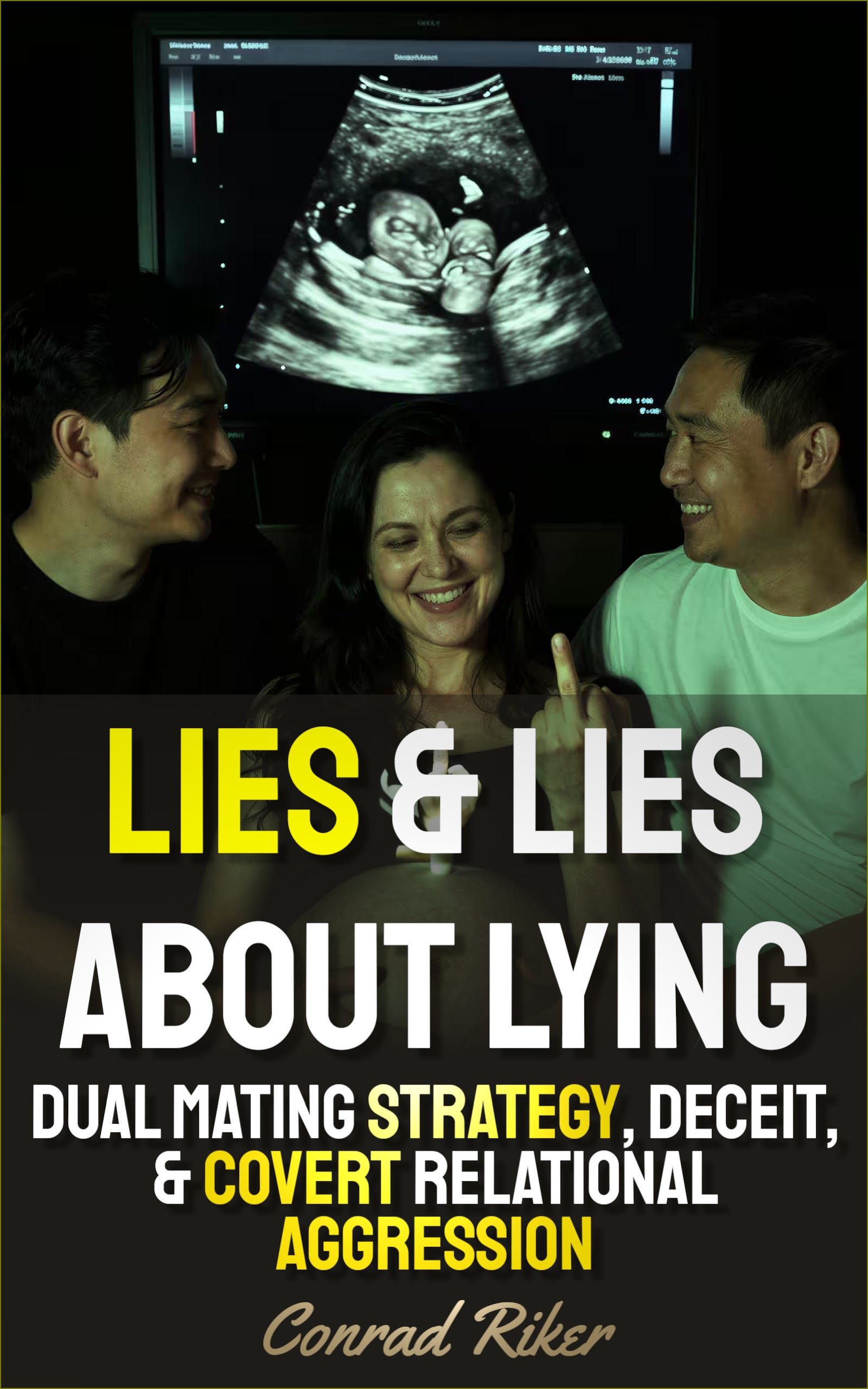
Lies & Lies About Lying: Dual Mating Strategy, Deceit, & Covert Relational Aggression
Buy on AMAZON or GOOGLE or SPOTIFY
You think you’re paranoid? Good. You should be. I was called paranoid too—until I started counting the lies. Not the big, dramatic ones, not the cheating scandals or the courtroom perjuries. I’m talking about the small, surgical cuts—the “I’m fine” when she’s clearly not, the “you misunderstood me” when she said it plain as day, the “I just want you to be happy” right before she ruins your life. I used to believe those. I used to apologize for things I didn’t do. I used to accept blame for emotions I didn’t create. I used to think if I just worked harder, loved better, provided more, the truth would win out. I was wrong. Dead wrong. And every time I tried to speak up, I was told I was toxic, that I was controlling, that I needed therapy. But here’s the truth they don’t want you to hear: the problem isn’t you. The problem is a system designed to make you doubt yourself while women lie with impunity.
This book isn’t for everyone. If you’re a soft-handed HR drone who thinks “emotional intelligence” means agreeing with every delusion your girlfriend throws at you, close this book now. If you’re a college girl who uses “gaslighting” as a weapon every time a man dares to set a boundary, go write another essay on “male fragility” and leave this to men who’ve bled for real knowledge. This book is for men who’ve been played, lied to, discarded, and then blamed for it. It’s for men who’ve watched their friends get destroyed by women who smile in their faces and stab them in the back. It’s for men who are tired of being told to “check their privilege” while their bank accounts, reputations, and families get stripped away by women who face zero consequences.
I’ve spent years studying this—not from some ivory tower, but from the trenches. I’ve seen marriages implode over lies so small they weren’t even worth telling. I’ve watched men lose everything because they trusted a woman who had no intention of being honest. I’ve seen the way women weaponize tears, the way they twist words, the way they use society’s double standards like a loaded gun. And I’ve seen the way institutions—from courts to churches to workplaces—bend over backward to protect female deception while crushing male honesty. This isn’t theory. This is war. And men are losing because they don’t even know the rules.
The chapters ahead aren’t polite. They’re not balanced. They’re not trying to “understand both sides.” There is no “both sides” when it comes to deception. A lie is a lie. A manipulation is a manipulation. And when the system rewards women for lying and punishes men for speaking up, silence isn’t wisdom—it’s suicide. You’ll learn how feminism rebranded deceit as empowerment. You’ll see how social media turned every woman into a performance artist, faking vulnerability while exploiting real men. You’ll understand why “toxic masculinity” is a scam designed to keep you weak and compliant. You’ll discover how the legal system treats a woman’s false accusation like gospel, while a man’s truthful defense is treated like a crime.
This book will show you the patterns—the repeated, predictable ways women lie, manipulate, and exploit. It will teach you how to see the lies before they land. How to stop reacting and start controlling the game. How to build unshakable mental strength so no woman can destabilize you again. This isn’t about revenge. It’s about survival. It’s about reclaiming your mind, your power, your life. If you’re ready to stop being the sucker in the audience, if you’re done being played, if you want to finally see the game for what it is—then this book is for you. Everyone else can keep believing the fairy tales. I’m done with them.
Buy on AMAZON or GOOGLE or SPOTIFY